I. Overview
(1) Structure
The School of Marxism comprises nine teaching and research groups, namely the Teaching and Research Group on “An Introduction to Xi Jinping Thought on Socialism with Chinese Characteristics for a New Era,”, the Teaching and Research Group on “An Introduction to Mao Zedong Thought and the Theoretical System of Socialism with Chinese Characteristics,”, the Teaching and Research Group on “Basic Principles of Marxism,”, the Teaching and Research Group on “Ideological Morality and the Rule of Law,”, the Teaching and Research Group on “Outline of Modern and Contemporary Chinese History,”, the Teaching and Research Group on “Current Affairs and Policy,”, the Teaching and Research Group on“Military Theory”, the Teaching and Research Group on “National Security Education,”, and the Teaching and Research Group on “Guangdong’s Pioneering Practices.”
(2) Faculty and student
All faculty members in the School hold at least a master’s degree. Among them, eight are PhD holders or PhD candidates, making up There are eightfaculty members with doctoral degrees or currently pursuing doctoral degrees, accounting for 36% of the total teaching faculty.
(III) Distinctive Features and Highlights
The School places great emphasis on the quality and social influence of its faculty. Since 2006, faculty members have consistently achieved outstanding results in provincial-level and higher teaching competitions, winning a total of 9 third-place or higher awards in the Guangdong Provincial Higher Education Institutions’ Ideological and Political Education Young Faculty Teaching Skills Competition, 2 third-place awards in the Provincial Young Faculty Teaching Competition, and 2 second-place awards in the Provincial Private Institutions “Micro Party Lecture” Competition. The school currently has 2 “Outstanding Teachers of Nanyue,”,1 university-level “Young Teaching Star,” 1 first-prize winner of the university-level “Top Ten Lecturers”, and 2 university-level “English-Only (Bilingual) Instructors”, forming a high-caliber faculty team with a well-balanced structure and dynamic energy.
The School thoroughly implements the spirit and requirements of national policies regarding the development of ideological and political theory courses in higher education institutions, fully leveraging the primary main channel role of these courses to enhance the pertinence relevance and effectiveness of ideological and political education. Through continuous deepening of curriculum reform, the School has established a comprehensive system of ideological and political courses, achieving significant results. It has been approved for 2university-level first-class undergraduate courses, 3 key courses, 3 high-quality open online courses, and 1 Guangdong Provincial High-Quality Resource- Sharing Course, laying a solid foundation for improving the relevance and effectiveness of ideological and political education.
The School adheres to the principle of using teaching and research to enriching instruction through teaching and research. Over the years, it has undertaken a total of four provincial-level or higherand above teaching reform projects and completed 24 university-level teaching reform and course-basedcurriculum ideological and political education projects, producing a number of distinctive achievements in teaching research and reform. The School also actively expands external cooperation, drawing on cutting-edge theories through the Regional Collaborative Innovation Center of the School of Marxism at SunYat-sen University, and achieving shared teaching resources and collaborative development through a partnership with the School of Marxism at Guangdong University of Foreign Studies.
Since its establishment, the School has supported research efforts through dedicated funding and the implementation of research incentive mechanisms, securing approval for six sub-provincial-level projects, 12 municipal and departmental-level projects, and three industry-sponsored research projects. In 2022, the Guangdong Red Culture Popular Science Base was approved asdesignated a Guangdong Provincial Social Science Popularization Base (Standard Type), jointly affiliated with the University Party Committee’s Organization Department and the School of Marxism, marking the School’s first provincial-level platform. To date, the School has published 116 papers in journals such as Thinking, Academic Research, and Inner Mongolia Social Sciences. Amongthese, 8 were published in CSSCI-indexed journals and 21 in Peking University Core Journals. The School’s research achievements have receivedwon 8 awards at various levels. It has also published 2 monographs.
In collaboration with the Student Affairs Office and the University Youth League Committee, the School has established the “Casting the Soul Through Light and Shadow · · Critical Thinking in Youth” Ideological and Political Micro-Film Festival as a regular flagship project for the “Grand Ideological and Political Education Course.” This initiative innovates educational platforms by encouraging students to create ideological and political micro-films, thereby transforming ideological and political education from classroom lectures into a profound visual creation process. Using the lens as their eyes and light and shadow as their voice, students profoundly interpret the reflections give powerful expression to the reflections and sense of responsibility of the youth in the new era. This initiative transforms micro-films into dynamic teaching materials and turns the creative process into an immersive practicumactice ground for “all-round education,” yielding significant educational outcomes.
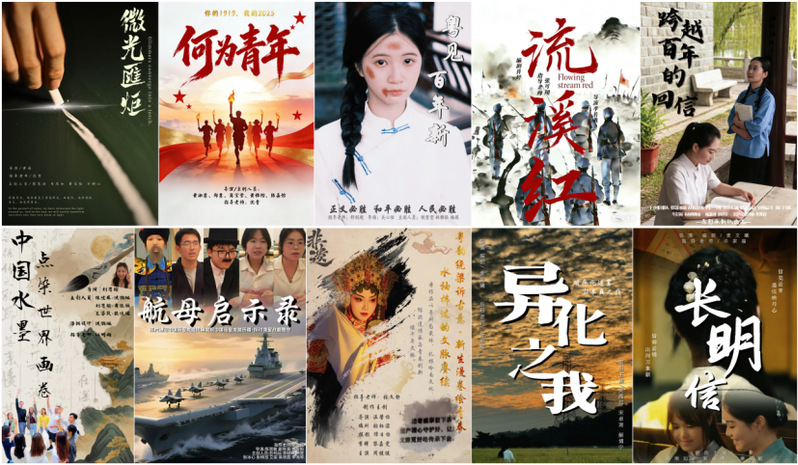
Figure 1 Posters of the 10 best movies of the 1st Ideological and Political Micro-Film Festival

